Battling Lawn Pests? Here’s What Actually Works

Pest damage is rarely about effort or bad luck. It’s almost always a symptom of two things working against you: timing problems and underlying lawn conditions that make your grass easy to attack in the first place.

Most homeowners focus their energy on which pest prevention to buy and how much to spread, when the bigger factors are when that product goes down and how healthy the lawn was before the pests ever showed up. A perfectly good treatment applied at the wrong time will disappoint nearly every time. It’s a piece of the puzzle the label never mentions.

Once you understand those two factors, the whole approach changes, and pest control starts to feel a lot less like guesswork. Here’s what the most common West Michigan lawn pests look like, why store-bought treatments so often fall short, and what professional care actually involves.

Image

Most lawn pest problems aren’t about effort or bad luck.
They come down to timing, identification, and
a lawn healthy enough to fight back.

Common Lawn Pests of West Michigan

The good news is that most pest problems in this region trace back to a short, familiar list of culprits. Knowing which one you’re actually dealing with is the first step towards fixing it, because the right response to one pest is often the wrong response to another.

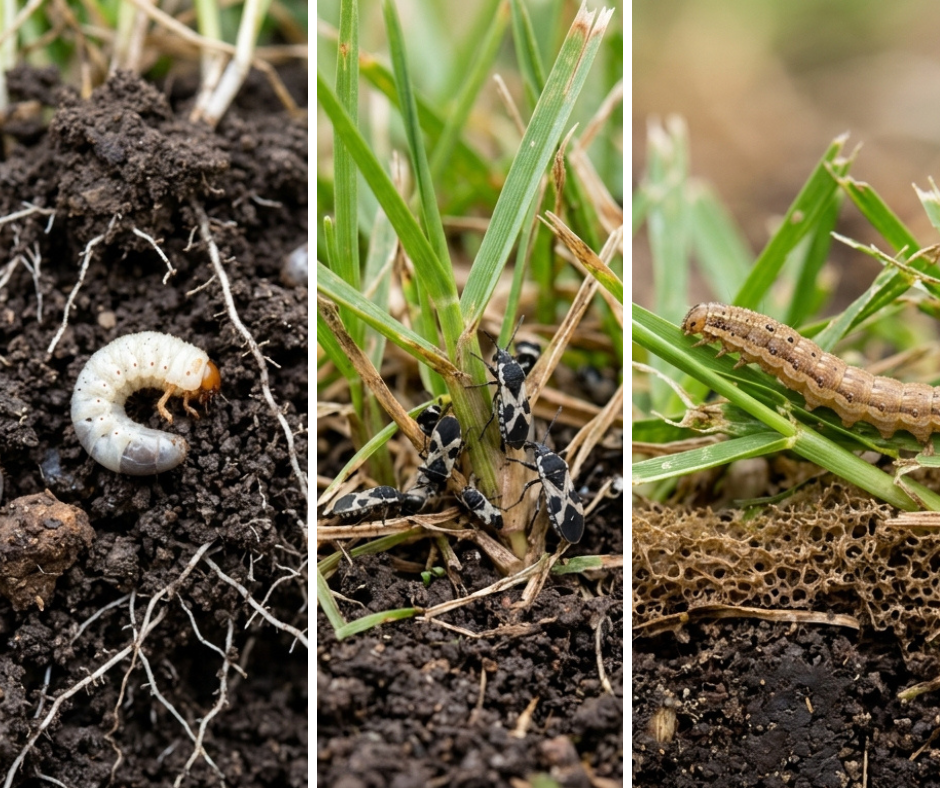
    πŸ› Grubs are the leading cause of patchy, spongy turf across West Michigan. These beetle larvae feed on grass roots just below the surface, severing the plant from its water and nutrient supply.
    πŸ› Chinch bugs show up during hot, dry summer stretches and are often mistaken for drought stress. They pierce grass blades and inject a toxin that kills grass from the outside in.
    πŸ› Sod webworms are another warm-season pest that chew grass blades down to the thatch layer, the spongy band of dead stems and roots that builds up between the green grass and the soil, leaving irregular brown patches that look like heavy foot traffic damage.
    πŸ› Surface damage from other animals Tunneling from moles or birds repeatedly pecking at your lawn usually points to a buffet of grubs just below the surface, so their presence is worth investigating.

By the time these signs show up, the visible damage is the symptom, not the source. The pests behind it have often been feeding for weeks, which is exactly why catching the problem early matters so much.

Lawn Care Mistakes That Make Pest Damage Worse

Some common lawn care habits unintentionally create conditions that make pest damage worse. For homeowners and property managers alike, small adjustments to routine care can make a measurable difference in how resilient your lawn is against insects.

    ⚠️ Cutting grass too short, even on a consistent schedule, stresses your lawn and weakens its defenses. Taller grass blades shade the soil, retain moisture, and support deeper root development.
    ⚠️ Watering often but lightly trains roots to stay close to the surface, which is exactly where grubs do the most damage. Deep, infrequent watering encourages roots to follow moisture further down into the soil.
    ⚠️ Skipping aeration keeps soil compacted over time. Compacted soil limits oxygen movement and reduces the effectiveness of any fertilizer or pest treatment you apply, because the product cannot reach the root zone where it is needed.

None of these adjustments require special equipment or expertise, just a few tweaks to the routine you already follow. Get them right, and you build a lawn that resists pests on its own, long before any treatment ever enters the picture.

Timing Matters More Than the Product You Choose

The most common reason DIY grub treatments fail has nothing to do with a weak or wrong product. It comes down to when the treatment is applied.

    πŸ“… Early summer is the window when most preventive treatments work best. This is when eggs are hatching and larvae are still small, feeding close to the surface, and most vulnerable.
    πŸ“… Grub treatments applied too late in the season lose their effectiveness. By mid to late summer, grubs have matured and moved deeper into the soil where surface applications cannot reach them.
    πŸ“… Reactive treatments after visible damage rarely restore a lawn fully. By the time brown patches appear, the root system is already compromised, and recovery depends on how much healthy grass remains.

For property managers overseeing multiple sites, missing this window on even one property can mean costly reseeding in the fall. For homeowners, it often means another full season of dealing with the same problem. Either way, getting the timing right the first time is far easier and less expensive than trying to repair any damage after it’s done.

Professional Treatment Removes the Guesswork

At CAMP, we do not apply treatments until we know what we are treating. Accurate pest identification is the first step, and it changes everything about how a problem gets addressed.

    βœ… Correct identification before any product is applied prevents wasted treatments and avoids unnecessary chemical use on a lawn that might have a different issue entirely.
    βœ… Licensed applicators calibrate treatments to the specific pest type, the size of the lawn, and the point in the pest’s life cycle when treatment is most effective.
    βœ… Ongoing monitoring catches new pests while they’re still easy to control. Early intervention spares you the harder, slower work of recovery.


We treat pest control as part of a longer relationship with your lawn, not a one-time application. The goal is a lawn that is healthy enough to resist pressure and resilient enough to recover when something does get through.

The Path to a Pest-Free Lawn

Lawn pests in West Michigan can feel like a problem you’ll never get ahead of, but the path forward is clearer than it looks. Effective pest control comes down to three things: correct identification, right timing, and a lawn that is already in good condition to fight back. No single product or single application solves that equation on its own.

The grub killer in your garage was never the weak link. The missing pieces were timing and the condition of the lawn underneath it. Once those line up, pest control stops being a yearly guessing game and starts being something you can count on.

Grubs? Chinch bugs? Something else entirely? We’re happy to take a look, identify what’s actually attacking your lawn, and put a stop to it. Reach out to CAMP Landscape Management and let us figure out what your lawn is up against.